
The country
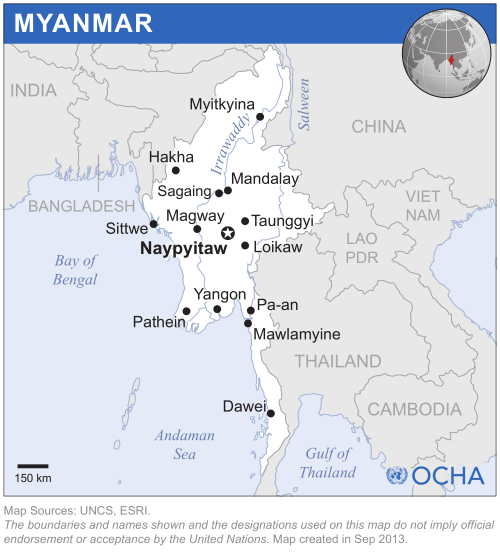
Myanmar, formerly Burma, is a Southeast Asian nation that borders India, Bangladesh, China, Laos, and Thailand. The country gained its independence from the United Kingdom on January 4, 1948. Its capital is Naypyitaw. Myanmar covers a land area of 676,578 square kilometers. As of 2026, the country has an estimated population of around 54.9 million people. Over half of Myanmar's population consists of diverse ethnic groups.
The humanitarian situation
Myanmar faces multiple and overlapping humanitarian emergencies caused by persecution, protracted armed conflict, intercommunal violence, and natural disasters such as earthquakes and cyclones. These needs have continued to mount due to ongoing armed violence and political unrest since the February 2021 military coup. The situation remains dire, with an estimated one-third of the country's 55 million people in need of assistance by 2026.
Humanitarian needs in Myanmar have risen dramatically since the military takeover five years ago, a situation that was further exacerbated by the devastating earthquake that hit the country in 2025. According to the 2026 Humanitarian Needs and Response Plan (HNRP), over 16.2 million people in Myanmar, including approximately 5 million children, require life-saving assistance and protection this year.
Often overlooked by the international media, Myanmar is one of the world's most dire and underfunded humanitarian crises. Armed conflicts, including airstrikes, artillery fire, and ambushes, have resulted in the large-scale displacement of civilians. Fighting affects most of the country, and the conflict is rated as one of the three deadliest in the world. Some 5.4 million people in Myanmar are displaced, either internally or across borders.
Due to severe underfunding in 2025, aid agencies plan to focus their efforts on the most vulnerable this year. They plan to assist only 4.9 million people in 2026, 2.6 million of whom are high priority. Due to global funding constraints, the HNRP has been drastically scaled back from targeting 6.7 million people in 2025, a figure that does not reflect any improvement on the ground.
Humanitarian organizations warn that millions could be left without necessary support if urgent funding is not mobilized. Intensifying conflict, recurrent disasters, and economic collapse have led to mounting humanitarian needs. Challenges to humanitarian access, underfunding, and service disruptions have left many essential needs unmet.
On March 28, 2025, Myanmar was hit by two powerful earthquakes, with the first measuring 7.7 on the Richter scale. The earthquakes killed more than 3,800 people, injured more than 5,000, and left 6.3 million people — including nearly 2 million children — in critical need of humanitarian assistance in the worst-affected areas. Prior to the earthquakes, more than two-thirds of these individuals were already facing a dire humanitarian situation due to ongoing conflict, climate-related disasters, displacement, and economic decline.
The earthquakes further worsened the plight of people who had been facing immense humanitarian needs since 2021. Those impacted immediately needed shelter, food, health services, water, sanitation, hygiene, and mental health and psychosocial support. The earthquakes were the largest to hit Myanmar in over a century. They caused widespread destruction of homes and severe damage to critical infrastructure across central Myanmar, including the Mandalay, Sagaing, and Bago regions, as well as Nay Pyi Taw and parts of Shan State. More than 55,000 houses were damaged or destroyed.
Approximately 10.4 million people lived in areas worst affected by the earthquake, including the cities of Mandalay, Sagaing, Magway, and Bago, as well as the regions of Shan State and Naypyidaw. The military government declared a temporary ceasefire to allow humanitarian aid to reach those affected after several opposition forces said they would cease hostilities following the earthquake. However, attacks by the Myanmar Armed Forces (MAF) have continued, reportedly killing hundreds of civilians in the aftermath of the earthquakes.
Conflict has caused unprecedented displacement. By the beginning of 2026, it had forced more than 3.8 million people to flee their homes — an all-time high and a staggering increase of nearly 1.5 million internally displaced persons (IDPs) since 2023. Of those displaced, approximately 300,000 were driven from their homes by conflict prior to February 2021, primarily in the states of Rakhine, Kachin, Chin, and Shan.
Additionally, approximately 1.6 million refugees and asylum seekers from Myanmar, primarily belonging to the Rohingya ethnic group, have sought refuge in neighboring countries. Since the military takeover in February 2021, approximately 300,000 people have fled the country. Nearly half of the refugees and IDPs are children.
For decades, the Rohingya, an ethnic Muslim minority, have faced institutionalized discrimination in Myanmar, including exclusion from citizenship. Since August 2017, ongoing conflict and violence in northern Rakhine State have forced over 900,000 people, primarily Rohingya, to flee to Bangladesh. Currently, nearly 1.2 million Rohingya refugees live in the Kutupalong and Nayapara refugee camps in Bangladesh’s Cox's Bazar region.
A safe return to Myanmar remains impossible for Rohingya refugees in Bangladesh as the conflict in Myanmar continues. More than eight years have passed since their massive exodus from Myanmar, and more people continue to flee the ongoing conflict to Bangladesh, where living conditions in the camps remain dire. Scarce livelihood opportunities and increased insecurity are pushing more and more refugees to risk dangerous journeys by boat to reach Malaysia, Indonesia, Thailand, and India.
Rising despair in Bangladesh’s refugee camps and ongoing violence in Myanmar are driving a dramatic increase in Rohingya risking perilous journeys across the Andaman Sea. The United Nations Refugee Agency (UNHCR) has issued several public warnings about the sharp increase in the number of people, mainly Rohingya, fleeing both Bangladesh and Myanmar by boat.
In May 2025, two boat tragedies off the coast of Myanmar resulted in the deaths of an estimated 427 Rohingya refugees, making it one of the deadliest tragedies involving Rohingya refugees attempting to find safety that year.
In 2024, more than 9,100 Rohingya attempted to flee by boat — a 200 percent increase from 2023. Over 650 people died or went missing en route, making it one of the most dangerous journeys in the world. According to UNHCR, more children embarked on the vessels in 2024, accounting for 44 percent of the total passengers, up from 37 percent in 2023. The proportion of women also increased to nearly a third.
In 2023, at least 4,490 Rohingya made the risky boat journey — an increase from 2022, when 3,705 Rohingya risked their lives. The majority of those attempting the journey across the Andaman Sea and the Bay of Bengal were women and children. In 2023, some 569 Rohingya were reported to have perished or gone missing in Southeast Asian waters.
Nearly a third of Myanmar's population is facing acute food insecurity. According to an early warning report released in June 2025 by the United Nations, Myanmar is one of the world’s most critical hunger hotspots and requires urgent attention to save lives and livelihoods. Meanwhile, Myanmar's health system is in disarray, and basic medicines are in short supply. It is estimated that 12 million people in Myanmar need emergency health assistance.
Myanmar is one of the world's three most vulnerable countries to extreme weather, frequently experiencing severe climate events such as cyclones, and floods. On May 14, 2023, Tropical Cyclone Mocha — one of the strongest storms in decades — made landfall in western and northern Myanmar and southeastern Bangladesh.
The cyclone caused widespread damage, affecting over 10 million people in both countries and exacerbating the already dire humanitarian situation. On May 23, 2023, the United Nations and its partners launched a $333 million flash appeal for donor support to assist the 1.6 million people affected by the cyclone in Myanmar's Rakhine, Chin, Sagaing, Magway, and Kachin states.
A year after Cyclone Mocha struck, flooding caused by the remnants of Typhoon Yagi and monsoon rains affected more than one million people nationwide in July and September 2024, worsening conditions for a population already at risk. The floods caused significant loss of life, with more than 360 deaths reported in several regions, and many more people were injured. The damage was particularly severe in the northwest, southeast, and Rakhine State.
Due to global funding cuts and a subsequent prioritization exercise conducted by the UN, the number of people prioritized for assistance in Myanmar has narrowed to just over 16 million for 2026. Aid agencies plan to focus their efforts on assisting the most vulnerable, aiming to reach 4.9 million people in 2026. However, because of global funding constraints, the HRNP has been drastically scaled back from the 6.7 million people targeted in 2025.
The highly prioritized response outlined in the HNRP 2026 is estimated to cost $890 million, significantly less than the $1.4 billion requested in 2025. However, this decrease does not reflect a reduction in human suffering. Rather, it reflects the reality of the global funding crisis, which has forced a narrower focus on addressing the most severe challenges and life-threatening conditions. The plan prioritizes $521 million in requirements to assist 2.6 million people.
Last year, the 2025 HNRP for Myanmar sought $1.1 billion to provide life-saving assistance to 5.5 million people. The humanitarian response in Myanmar has been chronically underfunded for years. By the end of the year, only 18 percent of the HNRP funding had been received.
Two weeks after devastating earthquakes struck Myanmar in March 2025, the United Nations and humanitarian partners launched a $275 million flash appeal as an addendum to the 2025 HNRP. The goal was to provide urgent assistance to 1.1 million people. Of the appeal, $210 million, or 76 percent, was received.
The 2025 Joint Response Plan (JRP) for the Rohingya Humanitarian Crisis requested $934.5 million from the international community to provide refugees in the camps with protection, shelter, basic necessities, and opportunities for self-reliance. However, at the end of the year, the JRP was only 52 percent funded.
In 2024, the people of Myanmar faced a deepening humanitarian crisis characterized by mounting needs amid unabated conflict, frequent monsoon flooding, and unprecedented displacement. The response was critically under-resourced. Despite ongoing access constraints and underfunding, aid agencies reached an estimated 3.9 million people that year.
The 2024 Myanmar HNRP aimed to assist 5.3 million of the most vulnerable individuals, requiring $994 million. However, by the end of the year, the plan had only received 36 percent of the requested funds, making it one of the least funded responses worldwide and drastically limiting the ability of aid agencies to provide assistance to those prioritized for urgent aid. The 2024 Rohingya JRP requested $852.4 million to assist 1.3 million people. Continued funding shortfalls undermined relief efforts. The JRP was only 57 percent funded by the end of the year.
The 2023 HNRP for Myanmar requested $887 million to provide lifesaving assistance to millions of people. As of December, the HRNP was only 33 percent funded. The 2023 Rohingya Joint Response Plan required $876 million. As of December, the response plan was only 49 percent funded.
Due to underfunding and access constraints, humanitarian organizations reached only 3.2 million people with humanitarian assistance in 2023. This meant that more than 1.1 million people were left without priority, life-saving assistance; nearly three-quarters of all planned shelter repairs and construction were not possible; and nearly 672,000 people did not have access to safe drinking water.
In 2022, the United Nations requested $826 million in funding for the Myanmar crisis. As of December 2022, only $291 million had been received from donors, providing 35 percent coverage. The Rohingya emergency in Bangladesh requested $881 million. As of December 2022, international donors had provided only $434 million (49 percent coverage).
In July 2023, the UN Human Rights Office (OHCHR) released a report that found the military's strategy to prevent life-saving humanitarian aid from reaching those in need exacerbated the humanitarian and human rights situation, including in the aftermath of Tropical Cyclone Mocha in May 2023. OHCHR stated that, even when humanitarian workers were granted access, their ability to deliver aid was strictly limited and controlled.
Relief efforts in Myanmar and neighboring Bangladesh in response to the Rohingya refugee crisis also remain dangerously and chronically underfunded. Due to funding shortages, the World Food Programme (WFP) was forced to cut food aid to Rohingya refugees in Bangladesh twice in 2023. In May, the WFP reduced food vouchers in Cox's Bazar, Bangladesh, to just $8 USD, which is less than nine cents per meal. In March, the WFP reduced its life-saving food vouchers from $12 to $10 per person per month.
Since January 2024, the WFP has increased monthly food vouchers back to $10 per person. In June 2024, the WFP partially increased food rations for all Rohingya living in refugee camps in Cox's Bazar, raising the monthly entitlement to $11 per person. In August 2024, the UN agency restored the full ration target of $12.50.
An estimated 1.2 million people currently reside in the world's largest refugee settlement in the Cox's Bazar region. High levels of food insecurity significantly affect refugees in Cox's Bazar, with 20 percent experiencing emergency levels (IPC 4) and 20 percent experiencing crisis levels (IPC 3). More than 81,000 Rohingya children are suffering from or are expected to suffer from acute malnutrition.
 The security situation
In August 2017, the Myanmar government launched a military campaign that forced 740,000 Rohingya to flee Rakhine State in Myanmar. The United States has accused the Myanmar government of committing genocide against the Rohingya people. An estimated 600,000 Rohingya people living in Rakhine State are unable to move freely and are subject to government persecution and violence.
On November 27, 2024, the Prosecutor of the International Criminal Court (ICC) announced he was seeking an arrest warrant for Myanmar's acting president, General Min Aung Hlaing, for crimes against humanity, including deportation and persecution of the Rohingya in 2017.
The Prosecutor's Office alleges that these crimes were committed by the MAF (also known as the Tatmadaw) between August 25 and December 31, 2017, and were supported by the national police, the border guard police, and non-Rohingya civilians.
On February 1, 2021, the military staged a coup and arrested State Counselor Aung San Suu Kyi, President U Win Myint, and other leaders of the ruling National League for Democracy (NLD). More than 6,700 people were killed in protests and unrest following the coup, at the hands of the military. Over 27,000 people were arrested.
In 2022, intense armed clashes in several states, exacerbated by tight security and restrictions on the movement of people and goods, threatened the lives and safety of the Myanmar people. Frequent, indiscriminate attacks, including airstrikes and artillery shelling in civilian areas, claimed lives and spread fear. Displacement increased, though some reported returnees. According to the Armed Conflict Location & Event Data Project (ACLED), Myanmar was by far the worst country in 2022 in terms of state-sponsored political violence against civilians.
In December 2022, the United Nations Security Council (UNSC) passed Resolution 2669 on Myanmar, a landmark resolution demanding that the military government immediately end the violence it has perpetrated in the Southeast Asian nation and release all prisoners detained arbitrarily. The UNSC reiterated the necessity of full, safe, and unhindered humanitarian access and underlined the need for scaled-up humanitarian assistance for all people in need in Myanmar. The UNSC also emphasized the importance of ensuring the full protection, safety, and security of humanitarian and medical personnel.
A report to the UN Human Rights Council, released in August 2023, found strong evidence that the Myanmar Armed Forces (MAF) and its affiliate militias are committing increasingly frequent and brazen war crimes. These war crimes include indiscriminate or disproportionate attacks on civilians from aerial bombing, the mass executions of civilians and detained combatants, and the large-scale and intentional burning of civilian homes and buildings, resulting in the destruction of entire villages in some cases.
In 2023, there was a staggering 270 percent increase in landmine and explosive remnant of war casualties compared to 2022, with over a thousand reported nationwide. Since late October 2023, clashes have intensified between ethnic armed organizations (EAOs) and the MAF. Hundreds of thousands have been displaced due to clashes and aerial bombardments. In November, the fierce fighting spread to other regions, including densely populated urban centers.
These clashes erupted following a sudden, coordinated attack by three ethnic minority–led rebel groups along the China–Myanmar border in northern Shan State. Dubbed "Operation 1027" for the date it began, the offensive was launched on October 27, 2023, by the "Three Brotherhood Alliance," consisting of the Myanmar National Democratic Alliance Army (MNDAA), the Ta'ang National Liberation Army (TNLA), and the Arakan Army (AA).
According to the United Nations, this escalation is the largest and most geographically widespread conflict since the military took power in 2021. The north and south of Shan State, Sagaing Region, Kayah State, Rakhine State, Chin State, Magway Region, and eastern Bago Region and Kayin State have been particularly affected. Since the operation began, armed conflict has spread to many parts of the country, especially Rakhine State in the northwest and Kachin and the southeast.
By 2025, armed conflict and fighting between the Myanmar Armed Forces (MAF) and non-state armed groups, including the EAOs and People's Defense Forces (PDFs), had impacted 12 out of 15 regions. The ongoing escalation of conflict in Myanmar severely affects people in almost every corner of the country and has alarming spillover effects into neighboring countries. The UN warns that the humanitarian impact is significant and deeply concerning.
From 2024 to 2025, Myanmar experienced the rapid expansion and unification of armed groups across the country. As the conflict continues in much of the country, people are forced to flee their homes in record numbers. According to ACLED, Myanmar was the second most conflict-ridden country in the world in 2024. It also ranked as the third deadliest and fourth most dangerous country for civilians, with 43 percent of the population exposed to conflict.
Civilians bear the brunt of the fighting between the MAF and non-state armed groups, experiencing deadly aerial bombardments and heavy shelling in residential areas. The humanitarian situation in Rakhine State is particularly alarming as fighting intensifies and intercommunal tensions rise. Meanwhile, humanitarian organizations are denied permission to operate, and movement throughout the country is severely restricted and unsafe.
In Rakhine, Myanmar's Rohingya ethnic minority is facing another wave of deadly violence eight years after a 2017 military-led campaign forced hundreds of thousands to flee to Bangladesh. This time, however, the perpetrators are reportedly the Arakan Army (AA), one of several ethnic armed groups fighting the country's ruling junta and Myanmar's security forces.
In May 2024, disturbing reports emerged of new atrocities being committed against the Rohingya population in northern Rakhine State. Intense fighting between junta forces and the Arakan Army has engulfed Rakhine, driving many thousands of Rohingya from their homes. Most are without adequate food, shelter, or medicine. In the last two years, tens of thousands have crossed the border into Bangladesh, with approximately 150,000 Rohingya refugees reaching the Cox’s Bazar region.
The conflict between the Myanmar Armed Forces and the Arakan Army escalated in November 2023 and now affects 16 out of 17 townships in Rakhine State. An estimated 500,000 people are displaced in Rakhine, including 290,000 who have fled their homes since November 2023.
Armed resistance groups have made significant advances in Myanmar, gaining control over large areas of territory. In response, the military regularly carries out airstrikes and artillery shelling in populated areas, resulting in an increasing number of civilian casualties. The fighting has been particularly intense in Rakhine State, where the Arakan Army took control of the regional military headquarters and numerous bases, obtaining nearly complete control of the state in 2024. Tens of thousands of Rohingya have been displaced as intense fighting between junta forces and the AA grips Rakhine.
Civilians caught between the military and the AA have faced frequent killings, disappearances, mutilations, arbitrary arrests, torture, destruction of villages, and widespread displacement. According to the UN, conditions currently remain unfit for the safe and sustainable return of Rohingya to Rakhine State.
According to the UN Office for the Coordination of Humanitarian Affairs (OCHA), the ongoing conflict in Myanmar endangers the lives, safety, and health of civilians. Heavy armed clashes, including aerial bombardment, artillery fire, and ambushes, have been reported in two-thirds of the country. When faced with armed resistance in 2025, the military responded with repeated aerial and artillery attacks on civilians and civilian infrastructure, even in the immediate aftermath of the devastating March earthquake.
On the fifth anniversary of the military coup that ousted Myanmar’s democratically elected government, UN Secretary-General António Guterres warned that a “cycle of impunity” persists. He called for renewed international pressure to halt the country’s deepening humanitarian and human rights crisis.
Guterres strongly condemned all forms of violence and urged all parties to the conflict to exercise maximum restraint and uphold international human rights and humanitarian law. He also called for enabling "safe, sustained, and unimpeded access for the United Nations and its partners to deliver humanitarian assistance and essential services to all those in need."
As Myanmar marked the fifth anniversary of the coup, the grim milestone coincided with the conclusion of the military's three-phase elections. These elections have polarized society and intensified violence rather than providing a credible political pathway.
The voting period between December 2025 and January 2026 was reportedly marked by intense violence. The Office of the High Commissioner for Human Rights (OHCHR) stated that credible sources verified the deaths of 170 civilians in 408 reported military aerial attacks during the voting period alone.
According to the OHCHR, elections were held in only 263 of the 330 townships. They were often held exclusively in urban centers under military control and in areas affected by conflict. As a result, significant portions of the population, including the displaced and ethnic minorities such as the Rohingya, were excluded.
Donations
Your donations for tthe Myanmar emergency and the Rohingya emergency can help United Nations agencies, international humanitarian non-governmental organizations (NGOs) and their local partners to rapidly provide water, food, medicine, shelter and other aid to the people who need it most.
Myanmar Humanitarian Crisis
- UN Crisis Relief: Myanmar crisis
https://crisisrelief.un.org/myanmar-crisis - World Food Programme: Myanmar emergency
https://www.wfp.org/emergencies/myanmar-emergency - UNHCR: Rohingya emergency
https://www.unhcr.org/rohingya-emergency.html - UNICEF: Rohingya crisis
https://www.unicef.org/emergencies/rohingya-crisis - Oxfam International: Bangladesh Rohingya refugee crisis
https://www.oxfam.org/en/what-we-do/emergencies/bangladesh-rohingya-refugee-crisis - IFRC: Myanmar: Complex emergency
https://www.ifrc.org/emergency/myanmar-complex-emergency
To find other organizations to which you can donate, visit: Humanitarian Crisis Relief, Refugees and IDPs, Children in Need, Hunger and Food Insecurity, Medical Humanitarian Aid, Vulnerable Groups, Faith-Based Humanitarian Organizations, and Human Rights Organizations.
Further information
- UN OCHA: Myanmar
https://www.unocha.org/myanmar - European Civil Protection and Humanitarian Aid Operations (ECHO): Myanmar / Burma
https://civil-protection-humanitarian-aid.ec.europa.eu/where/asia-and-pacific/myanmarburma_en - UNHCR USA: Rohingya Refugee Crisis Explained
https://www.unrefugees.org/news/rohingya-refugee-crisis-explained/ - International Crisis Group: Myanmar
https://www.crisisgroup.org/asia/south-east-asia/myanmar - ACAPAS: Myanmar
https://www.acaps.org/en/countries/myanmar - Human Rights Watch: World Report 2026: Myanmar
https://www.hrw.org/world-report/2026/country-chapters/myanmar - Human Rights Watch: World Report 2025: Myanmar
https://www.hrw.org/world-report/2025/country-chapters/myanmar - Human Rights Watch: World Report 2024: Myanmar
https://www.hrw.org/world-report/2024/country-chapters/myanmar - Human Rights Watch: World Report 2023: Myanmar
https://www.hrw.org/world-report/2023/country-chapters/myanmar - Amnesty International: Report 2024/2025: Human rights in Myanmar
https://www.amnesty.org/en/location/asia-and-the-pacific/south-east-asia-and-the-pacific/myanmar/report-myanmar/
Last updated: 23/02/2026