
The region
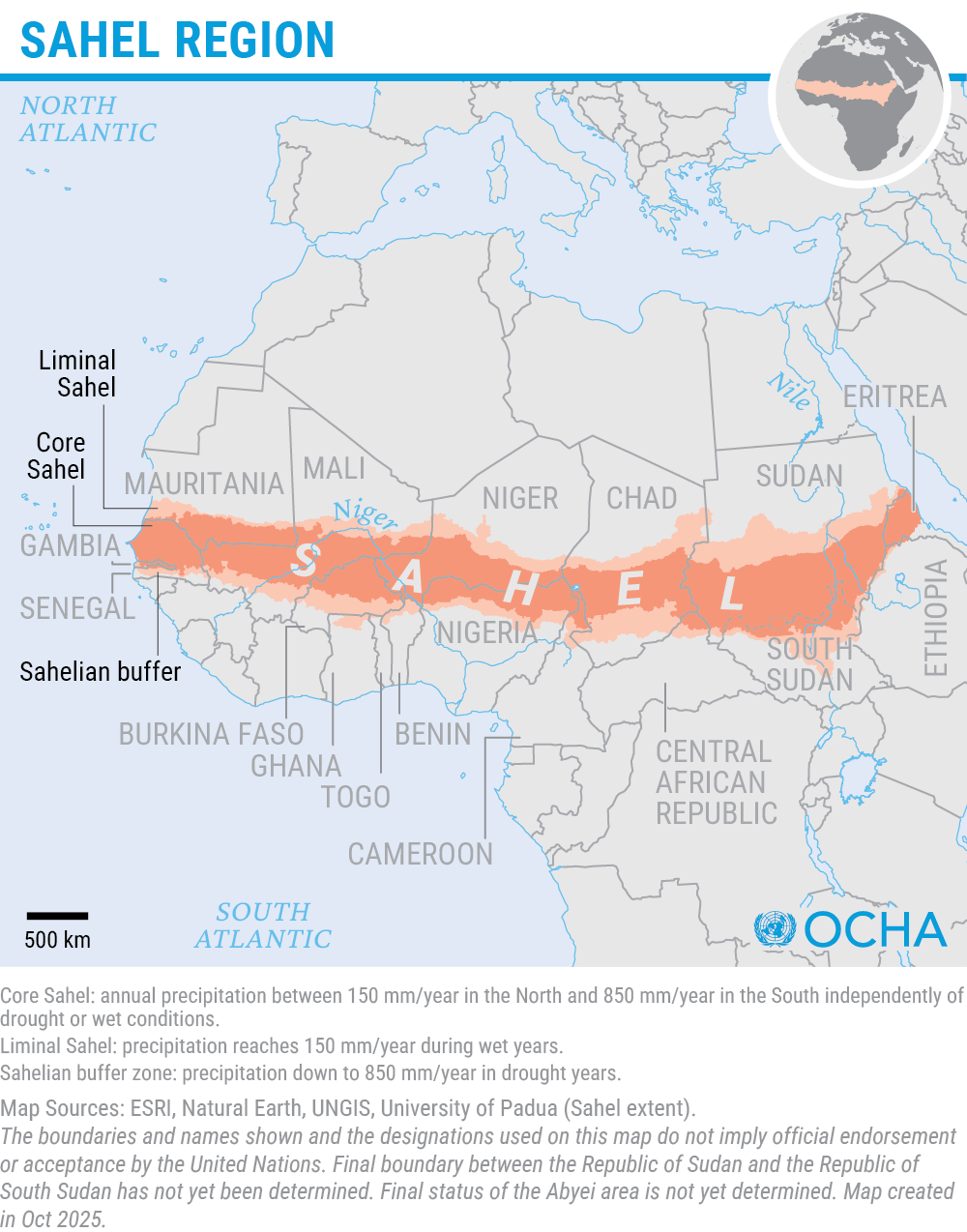
In geographic terms, Africa’s Sahel region stretches across the continent from east to west—a semi-arid belt that lies between the Saharan desert to the north and savannas to the south. The word Sahel comes from Arabic and means "coast" or "shore of the desert". In geopolitical terms, the Sahel is a vast region in Africa that includes the countries of Burkina Faso, Chad, Mali, Niger, northern Cameroon (Far North region), and northern Nigeria. The countries of the Sahel are among the least developed in the world. Niger, Chad, Burkina Faso and Mali rank at the bottom of the Human Development Index (HDI).
The humanitarian situation
The Sahel region is experiencing one of the world's worst humanitarian crises, with over 26 million people in need of humanitarian assistance in 2026. At the same time, it is one of the most overlooked regions. The main drivers of the region's unprecedented humanitarian needs are armed conflict, deteriorating security, political instability, and widespread poverty, particularly in the Central Sahel region, which includes Burkina Faso, Mali, and western Niger, as well as the Lake Chad Basin, which covers parts of Cameroon, Chad, Niger, and Nigeria.
The deteriorating humanitarian emergency is further compounded by the impact of the climate crisis and global food insecurity. Rapid climate change is causing natural disasters, such as heavy flooding, to occur more frequently and severely. The latest waves of displacement have pushed the total number of people forced to flee to over 10 million.
As of March 2026, more than 7.4 million people were internally displaced within their own country in the Sahel. Most of them were in Burkina Faso (2.1 million internally displaced persons (IDPs)), Nigeria (3.6 million IDPs), and Cameroon (500,000 IDPs). At least 2.6 million people have sought refuge in neighboring countries, which is a 27 percent increase compared to the previous year.
All six of the most affected countries — Burkina Faso, Cameroon, Chad, Mali, Niger, and Nigeria — made it onto the 2026 Emergency Watchlist released by the International Rescue Committee (IRC). The Norwegian Refugee Council (NRC) has identified situations in Burkina Faso, Cameroon, and Mali as some of the most neglected displacement crises worldwide.
An estimated 26 million people across the six hardest-hit countries will be in need of humanitarian aid in 2026: Burkina Faso (4.5 million), Cameroon (2.9 million), Chad (4.5 million), Mali (5.1 million), Niger (3.1 million), and Nigeria (5.9 million). Compared to 2025, this marks a decrease in the number of people requiring humanitarian assistance in these same countries: Burkina Faso (5.9 million), Cameroon (3.3 million), Chad (7 million), Mali (6.4 million), Niger (2.7 million), and Nigeria (7.8 million).
However, the decrease of more than 20 percent from last year does not reflect an overall improvement in the humanitarian situation. Rather, it is due to the adoption of methods focused on the people and areas most affected by severe shocks due to a critical shortage in global humanitarian funding.
The humanitarian situation was even more severe in 2024, when 35.2 million people across the Sahel and neighboring countries were in urgent need of life-saving assistance and protection. The six most affected countries were Burkina Faso (6.3 million), Cameroon (3.4 million), Chad (6 million), Mali (7.1 million), Niger (4.5 million), and Nigeria (7.9 million).
In 2023, 37.8 million people were in urgent need of life-saving humanitarian assistance and protection. Of those, 24.1 million people were in need of humanitarian assistance in the Lake Chad Basin countries (Nigeria, Niger, Chad, and Cameroon), and 13.7 million people required aid in the central Sahel countries of Burkina Faso and Mali. The six countries where millions of women, men, and children were in need of humanitarian assistance were: Mali (9 million), Nigeria (8.3 million), Chad (6.9 million), Cameroon (4.7 million), Burkina Faso (4.7 million), and Niger (4.2 million).
Burkina Faso: The people of Burkina Faso continue to experience a multidimensional humanitarian crisis that has worsened significantly since 2019. Approximately 2.1 million people remain displaced within the country. Armed groups have effectively blocked off areas where more than one million people live or have sought refuge, depriving them of free movement and necessary supplies.
Mali: Mali is experiencing enormous humanitarian needs, with 5.1 million people estimated to rely on humanitarian assistance by 2026. Currently, some 855,000 people across Mali are affected by crisis or worse levels of hunger. This figure is expected to rise to 1.56 million during the lean season in 2026. The departure of the United Nations Multidimensional Integrated Stabilization Mission in Mali (MINUSMA) in 2023 resulted in fresh hostilities and impacted conflict dynamics.
Niger: Niger continues to face a combination of crises, including persistent armed conflicts, climate-induced disasters, nutritional emergencies, and epidemics. These crises have been exacerbated by political instability following a military coup in 2023. An estimated 3.1 million people need humanitarian aid in 2026. Currently, 1.9 million people are food insecure, a number that will rise to 2.4 million during the lean season.
Chad: In Chad, protracted and rapid-onset multidimensional crises, aggravated by climate change, have created a challenging humanitarian situation, leaving 4.5 million people in need of aid. One of the recent crises in Chad has been the influx of Sudanese refugees and Chadian returnees since April 2023. Since the start of the Sudan war, more than 1.3 million refugees and Chadian returnees have arrived. As of March 2026, Chad was hosting over 2 million refugees. Currently, some 1.9 million people in Chad are facing acute food insecurity at a crisis level or worse, and this number is projected to reach 3 million between June and August 2026.
Cameroon: In Cameroon, 2.9 million people urgently need humanitarian assistance due to complex and multifaceted crises, including armed conflict causing internal and cross-border displacement, intercommunal violence, disease outbreaks, and seasonal flooding. The country remains home to 500,000 IDPs. Additionally, Cameroon is hosting more than 426,000 refugees and asylum seekers.
Nigeria: Armed conflict in northeast Nigeria continues to adversely affect the lives and prospects of 5.9 million people, 60 percent of whom are children. Some 3.7 million people are displaced within the country, including 2.1 million IDPs in the Northeast and approximately 1 million in the Northwest and the Northcentral regions. Humanitarian agencies warn that the ongoing crisis in the Northwest and Northcentral is being neglected. Hundreds of thousands have been displaced there due to banditry and armed violence, including farmer-herder violence.
An unprecedented food crisis is ongoing in the Sahel, driven by conflict, soaring food prices in global markets, and a decline in agricultural production due to climate change, violence, and displacement. From October to December 2025, 37.5 million people in the Sahel experienced acute food insecurity (at crisis levels or worse), including 27 million in Nigeria, 3.1 million in Cameroon, an estimated 2.7 million in Burkina Faso, 1.9 million in Niger, 1.9 million in Chad, and 900,000 in Mali.
From June to August 2026 — the lean season — this figure is expected to rise to 47.7 million, including 34.8 million in Nigeria, 2.9 million in Cameroon, an estimated 3 million in Burkina Faso, 1.6 million in Mali, 2.4 million in Niger, and 3 million in Chad.
Four countries—Nigeria, Chad, Cameroon, and Niger—account for 77 percent of the food insecurity figures. This includes 15,000 people in northeastern Nigeria's Borno State who are at risk of catastrophic hunger (IPC Phase 5) for the first time in nearly a decade, which indicates a severely strained food security situation.
A toxic combination of surging conflict, displacement, and economic turmoil has driven hunger in the region. However, reductions in humanitarian assistance are now pushing communities beyond their ability to cope. Humanitarians report that reduced funding in 2025 has exacerbated hunger and malnutrition across the Sahel region.
Millions of children under the age of five in the six Sahel countries are acutely malnourished or expected to suffer from acute malnutrition. Humanitarians warn that children in the region could die in devastating numbers unless urgent support is provided, as severe malnutrition and the risk of waterborne disease converge.
Drought and conflict are driving water insecurity in Burkina Faso, Chad, Mali, Niger, and Nigeria, where 40 million children face high to extremely high levels of water vulnerability. According to the World Health Organization (WHO), more children die from unsafe water and sanitation in the Sahel region than anywhere else in the world.
In 2024, persistent heavy rains and severe flooding affected several Sahelian countries, impacted some 6 million people, displaced nearly one million, and caused over 1,500 deaths. This extreme weather exacerbated existing humanitarian crises in Chad, Niger, Nigeria, Cameroon, Mali, and Burkina Faso.
Torrential rains and flooding inundated large areas, destroying homes, public health facilities, water systems, schools, sanitation facilities, roads, infrastructure, and farmland. Additionally, limited access to water, sanitation, and hygiene services increased the risk of waterborne disease outbreaks.
The extreme flooding in 2024 followed devastating floods in the Sahel and neighboring regions in 2022, exacerbating the needs of millions of people. In Nigeria, Chad, Niger, Burkina Faso, Mali, and Cameroon, above-average rainfall and flooding killed hundreds, displaced thousands, and affected millions.
Without sufficient resources for humanitarian action, the Sahel crisis risks further escalation, putting millions more children, women, and men at risk. As always, women and children are bearing the brunt of this crisis.
In 2025, aid agencies requested $4.9 billion to provide lifesaving assistance to 10.4 million of the most vulnerable people in Burkina Faso, Cameroon's Far North Region, Chad, Mali, Niger, and Nigeria's Adamawa, Borno, and Yobe States. However, as of March 2026, only $1.4 billion, or 29 percent, had been received.
The security situation
The Sahel is one of the most conflict-ridden regions in the world. Deteriorating security is exacerbated by increasingly extreme weather events related to climate change, deep poverty, and unprecedented levels of food insecurity and malnutrition. Violence and armed conflict are the main drivers of humanitarian needs in the region. Amid the instability caused by military coups and conflicts fueled by non-state armed groups, the region's populations face enormous challenges.
Over the past decade, the Sahel has experienced increasingly violent armed conflicts, accompanied by the rapid emergence of extremist groups such as Al-Qaeda, the Islamic State, and Boko Haram. The rise of these non-state armed groups has fueled intercommunal violence, resulting in thousands of deaths. Intense and indiscriminate violence has forced millions to flee across the Sahel, both within countries and across borders.
The two subregions of greatest concern are the Liptako Gourma region — also known as the tri-border area — which encompasses contiguous areas in northern Burkina Faso, southern and central Mali, and southwestern Niger, and the Lake Chad Basin — an area that includes parts of Cameroon, Chad, Niger, and Nigeria. Attacks on civilians and infrastructure, as well as conflicts between state and non-state armed groups, have led to massive population displacement in Burkina Faso, Cameroon, Chad, Mali, Niger, and Nigeria.
Displaced people are often cut off from their fields and pastures, which makes it impossible to grow essential crops for food security. Additionally, climate shocks, such as deadly floods in 2022 and 2024 that impacted millions, are claiming lives, destroying livelihoods, and disrupting agricultural productivity.
Liptako Gourma region
The Central Sahel region is experiencing one of the fastest-growing and most overlooked humanitarian crises in the world. Armed conflict, deteriorating security, political instability, and widespread poverty are the main drivers of these unprecedented needs. Security incidents, attacks, and abductions are a daily reality for millions of civilians and humanitarian workers.
The humanitarian situation in Burkina Faso, Mali, and western Niger continues to deteriorate due to ongoing conflict, escalating insecurity, increasing displacement, and limited humanitarian access. According to the Armed Conflict Location & Event Data Project (ACLED), the number of violent incidents climbed to over 3,730 last year, resulting in the deaths of more than 9,360 people.
Meanwhile, the number of IDPs reached 2.8 million, and the number of refugees rose to 440,000—clear signs of the conflict's intensity and geographic expansion across the region.
Escalating militant Islamist violence in Burkina Faso, particularly against civilians, continues to displace people. Violence associated with Islamist militant groups, particularly the Macina Liberation Front and the Islamic State of the Greater Sahara (ISGS), is expected to increase further in 2026.
Burkina Faso's security situation deteriorated following two military coups in January and September 2022. Currently, more than 1 million people across the country live in areas blockaded by armed groups, lacking access to basic services. The situation has become increasingly dire, with some people being forced to eat leaves just to survive. Non-state armed groups currently control nearly 40 percent of Burkina Faso's territory.
These patterns are also evident in Burkina Faso's neighbors, Mali and Niger. Mali experienced a military takeover in May 2021. Currently, some 415,000 people are internally displaced in Mali. Additionally, the Central Sahel state hosts tens of thousands of refugees, most of whom have fled insecurity in neighboring countries. More than 200,000 Malian refugees are hosted by neighboring countries, including Mauritania, Niger, and Burkina Faso. In July 2023, Niger's presidential guard staged a coup, installing a general as ruler.
Attacks by organized armed groups in the Liptako Gourma region put civilians in danger, prevent affected populations from accessing vital services, restrict humanitarian access, and worsen food insecurity. Security incidents, attacks, and abductions are a daily reality for millions of civilians and humanitarian workers in the region.
Attacks on civilians and infrastructure, as well as clashes between state and non-state armed groups, have led to massive displacement. The conflict is spreading throughout the region and even into coastal countries, posing a risk of instability in new and previously stable areas. West African coastal countries are experiencing the growing humanitarian consequences of the Sahel crisis spillover.
Lake Chad Basin
The Lake Chad Basin, which covers parts of Cameroon, Chad, Niger, and Nigeria, remains one of the most fragile regions in the world. A combination of protracted humanitarian crises caused by conflict, food insecurity, chronic malnutrition, natural hazards, limited state presence, rapid demographic growth, and the increasing impact of climate change affect the region.
The humanitarian situation in the Lake Chad Basin is highly fragile and complex. Large-scale displacement and growing constraints on financial resources across Nigeria, Niger, Chad, and Cameroon shape this situation. According to ACLED, there were over 920 security incidents in 2025 that resulted in more than 1,360 deaths, reflecting pervasive insecurity throughout the year. Consequently, widespread displacement continues.
There are 3 million internally displaced people, and the refugee population has risen to 436,000, highlighting the region's ongoing instability and limited prospects for safe and voluntary returns. The population of the Lake Chad Basin continues to be affected by violence, conflict, and insecurity.
Though some improvements have been made thanks to joint efforts by local and national governments, civil society organizations, and the international community, the Lake Chad Basin region still faces a protracted, complex crisis caused by extreme poverty, climate change, ongoing violent conflict, and a shortage of social services.
Parts of the Lake Chad Basin have also seen a deterioration in security conditions as armed groups continue to attack civilians, particularly in Cameroon's Far North region and northeast Nigeria. Increased gang violence has also been reported in northwest Nigeria, where the food situation is deteriorating as well.
Approximately 10 million people in the Lake Chad Basin crisis area require humanitarian assistance, but funding shortfalls severely limit the scale and coverage of the humanitarian response. Vulnerable populations continue to face severe food insecurity and malnutrition, while access to basic services has declined.
Donations
Your donation for the Sahel emergency can help United Nations agencies, international humanitarian non-governmental organizations (NGOs) and their local partners to rapidly provide water, food, medicine, shelter and other aid to the people who need it most.
- UN Crisis Relief: Sahel crisis
https://crisisrelief.un.org/sahel-crisis - UN Crisis Relief: Nigeria crisis
https://crisisrelief.un.org/nigeria-crisis - World Food Programme: Sahel emergency
https://www.wfp.org/emergencies/sahel-emergency - UNHCR: Sahel emergency
https://www.unrefugees.org/emergencies/sahel-crisis/
Currently, many NGOs are appealing for the global hunger crisis. You may also consider making an unearmarked donation or a broader earmarked donation.
- Plan International: Hunger Crisis Appeal
https://plan-international.org/emergencies/hunger-crisis-appeal/ - Action Against Hunger: Overall Emergency Relief
https://www.actionagainsthunger.org/donate/emergency-relief-response - Oxfam International: Donate to the Global Emergency Fund
https://www.oxfam.org/en/donate/global-emergency-fund - International Rescue Committee: Donate
https://help.rescue.org/donate/ - Norwegian Refugee Council (NRC): Donate
https://www.nrc.no/make-a-difference-today/
To find other organizations to which you can donate, visit: Humanitarian Crisis Relief, Refugees and IDPs, Children in Need, Hunger and Food Insecurity, Medical Humanitarian Aid, Vulnerable Groups, Faith-Based Humanitarian Organizations, and Human Rights Organizations.
Further information
- World Health Organization (WHO): Humanitarian crisis in Sahel region of Africa
https://www.who.int/emergencies/situations/humanitarian-crisis-in-sahel-region-of-africa - European Civil Protection and Humanitarian Aid Operations (ECHO): Sahel
https://civil-protection-humanitarian-aid.ec.europa.eu/where/africa/sahel_en - USA for UNHCR: Sahel Crisis
https://www.unrefugees.org/emergencies/sahel/ - International Crisis Group: Sahel
https://www.crisisgroup.org/africa/sahel
Last updated: 24/03/2026