
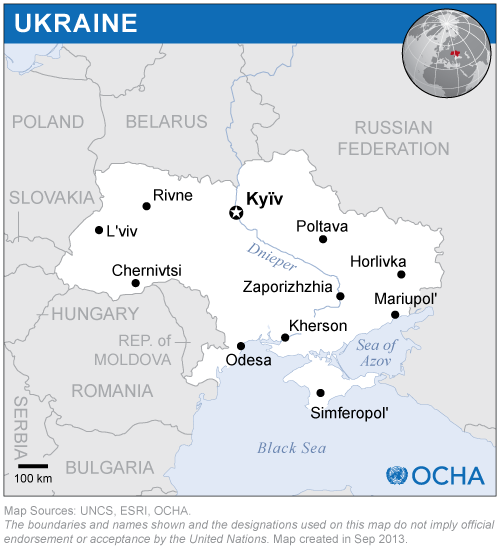
The country
Ukraine is a country in Eastern Europe, bordering the Black Sea and the Sea of Azov. The country regained independence in 1991 with the dissolution of the Soviet Union (the Union of Soviet Socialist Republics, USSR). Its capital is Kyiv. Ukraine shares land borders with Russia, Belarus, Poland, Slovakia, Hungary, Romania and Moldova. The country covers an area of 603,550 square kilometers. In 2026, Ukraine has an estimated population of about 34.2 million people, making it one of the most populous countries in Europe. The Eastern European nation is neither a member of the European Union (EU) nor the North Atlantic Treaty Organization (NATO).
The humanitarian situation
Within weeks, Russia’s invasion of Ukraine in February 2022 created one of the largest humanitarian disasters globally. As of June 2026, more than 62,000 civilians were recorded killed or wounded as a result of the war. Violations of international humanitarian law and international human rights law occurring in the course of the ongoing armed attack are widespread. As Russia’s full-scale invasion of Ukraine continues into its fifth year, people in Ukraine continue to be killed, wounded and deeply traumatized by the violence. Civilian infrastructure on which they depend continues to be destroyed or damaged.
In 2026, 10.8 million people inside Ukraine are in need of humanitarian assistance due to the conflict. The war in Ukraine has led to one of the three major displacement crises in the world - the others being the war in Sudan and the war in Syria - with more than 10 million people force to flee their homes.
As of June 2026, an estimated 6 million people have sought refuge in other countries, primarily Russia, Poland, and Germany. Meanwhile, nearly 4 million people remain internally displaced within Ukraine, and new waves of displacement are occurring in the north and east due to ongoing hostilities. However, the actual number of displaced Ukrainians may be much higher, as these numbers do not fully reflect those who have sought refuge in Russia.
Since February 2022, the UN has documented the deaths and injuries of more than 62,000 Ukrainian civilians, including over 3,000 children. From February 2022 to May 2026, over 16,500 civilians, including hundreds of children, were killed in Ukraine, and over 46,500 people were injured.
As these are UN-verified figures, the actual numbers are thought to be much higher. According to human rights monitors, many reports, particularly from certain locations and from the immediate aftermath of February 24, 2022, are still being verified due to the large volume of reports, while others could not be verified due to a lack of access.
Latest findings by the UN Human Rights Monitoring Mission in Ukraine (HRMMU) establish a worrying trend: More civilians were killed or injured in Ukraine in May 2026 than in any other month in the past four years. HRMMU verified that at least 274 civilians were killed and 1,763 were injured.
In previous years, the number of casualties steadily climbed from spring to summer. So far in 2026, casualty figures have followed the same pattern but at a significantly higher level than in previous years. According to the UN monitors, Russia's use of powerful weapons in urban areas was the main reason for the high number of casualties in May. Attacks involving missiles and aerial bombs killed and injured dozens of civilians in urban areas on multiple occasions.
2025 had been the deadliest year for civilians since the start of the full-scale invasion in 2022. At least 2,500 civilians were killed and over 12,000 were injured last year, which was a 30 percent increase compared to 2024.
The war continues to cause deep suffering for millions of people across Ukraine. More than four years after the escalation of the war in Ukraine, humanitarian needs remain high. Millions of people across the country have endured years of intense hostilities without adequate access to food, water, health care, education, protection and other essential services. Massive destruction of civilian infrastructure has left hundreds of thousands of Ukrainians without homes or livelihoods. An estimated 2.5 million families remain without an appropriate shelter.
Front-line areas and border regions continue to face the greatest humanitarian needs due to intensified shelling, destruction of civilian infrastructure, and ongoing disruptions to essential services. Repeated missile and drone strikes across the country continue to cause civilian casualties, damage homes, and force people to flee.
People living on the frontlines in the east, south and north of the country - an estimated 3.3 million people - and in Russian-occupied territory are particularly vulnerable. The impact of the war is widespread and uneven, with the most vulnerable suffering the most: internally displaced persons (IDPs), children and youth, people with illnesses, people with disabilities, the elderly, and LGBTQI+ people.
The conflict’s devastating impact on civilians is further exacerbated by severe and widespread attacks on healthcare in Ukraine. As of June 2026, the World Health Organization (WHO) has verified more than 3,094 attacks affecting healthcare facilities, personnel, transport, supplies and patients since the start of full-scale war in the country three years ago, with 239 deaths and 1013 injuries reported.
Last year, an estimated 9.2 million people in Ukraine were in need of some form of health assistance from aid agencies. More than four years of relentless conflict have left Ukrainians traumatized and facing an uncertain future. The war has had a devastating impact on the mental health and well-being of children, including the millions who had to flee the country for safety, whether internally or outside.
Humanitarians warn that the "hidden crisis" - the mental health crisis - will reverberate for generations. According to the UN, some 63 percent of households have reported mental health problems, while an estimated 1.5 million children are at risk of post-traumatic stress disorder (PTSD), and are in urgent need of support to cope with stress, anxiety, and other mental health challenges associated with the hostilities.
Humanitarian access is difficult in conflict zones, particularly near the eastern and southern fronts and in areas controlled or occupied by Russian forces. The United Nations and aid agencies lack humanitarian access to parts of the Russian-occupied Donetsk, Kherson, Luhansk, and Zaporizhia regions, where at least 1.5 million people are in need of humanitarian assistance, including access to health care and medicines, food, livelihoods, and safe drinking water.
Despite receiving significantly less funding than requested, humanitarian organizations reached 5 million people out of 6 million targeted across Ukraine in 2025. This included over 700,000 IDPs. More than 500 relief organizations participated in the relief efforts. Due to massive funding constraints, relief agencies were unable to fully meet critical needs.
However, in 2024, humanitarian agencies were still able to provide at least one form of assistance to 8.5 million people, with over 60 percent of those reached being women and girls. More than 600 humanitarian organizations, including more than 400 national non-governmental organizations (NGOs), provided assistance that year.
Ukrainian authorities in general allow unhindered access for relief organizations. Missile attacks and other airstrikes on large urban centers impact humanitarian operations across the country, particularly hampering the movement of aid workers and delivery of emergency supplies in eastern Ukraine, where people are in desperate need of assistance.
In 2026, an estimated 10.8 million people are in need of humanitarian assistance, while some 4.1 million are targeted for humanitarian aid, with 3.6 million highly prioritized. Yet, this decrease from 2025 does not reflect an improvement in the situation, but rather a more focused and highly prioritized response. The financial requirement for 2026 is $2.3 billion, of which $ 2.1 billion is prioritized, down from $2.6 billion in 2025.
The UN humanitarian office (OCHA) warns that funding shortages continue to limit the response and threaten the continuity of essential services. As of June 2026, the Humanitarian Needs and Response Plan (HNRP) was only 56 percent covered by funding.
More than one-third of the people in Ukraine - 12.7 million people - were in urgent need of humanitarian assistance last year. In 2025, the HNRP aimed to reach one-sixth of people in need, 6 million of the most vulnerable. The United Nations appealed for an overall US$3.83 billion to fund the ongoing humanitarian response inside the country and for the refugee crisis.
The lion's share of the twin humanitarian and refugee response plans for 2025 - $2.63 billion - was aimed at supporting those inside Ukraine in need of humanitarian assistance. However, as of December 2025, the humanitarian appeal for Ukraine had received only $1.4 billion in funding. A smaller amount - $690 million - was sought to provide assistance and protection to more than 2 million Ukrainians who have been forced to flee their homes and seek refuge in 11 Eastern European host countries bordering Ukraine.
In 2024, some 14.6 million people in the country were in need of humanitarian assistance and protection. 56 percent of whom were women and girls. At least 17.6 million people in Ukraine required humanitarian assistance in 2023. Among them were 5.5 million children. Humanitarian aid agencies provided life-critical aid and protection services to 11 million people across the country in 2023.
The 2024 Humanitarian Needs and Response Plan (HNRP) requested US$3.1 billion and targeted 8.5 million people within the war-torn country. As of December 2024, the HNRP was only 62 percent funded. UNHCR, which coordinated the Regional Refugee Response Plan (RRP), was seeking $1.1 billion last year, targeting 2.3 million refugees and host communities. As of December, the RRP was only 37 percent covered by funding.
In 2023, OCHA and UNHCR had jointly appealed for US$5.6 billion (€5.24 billion) to ease the plight of millions of people affected by the war against Ukraine. The Humanitarian Response Plan for Ukraine called for $3.9 billion to reach 11.1 million people with food, health care, cash and other life-saving assistance. The Refugee Response Plan (RRP) for refugees from Ukraine appealed for $1.7 billion.
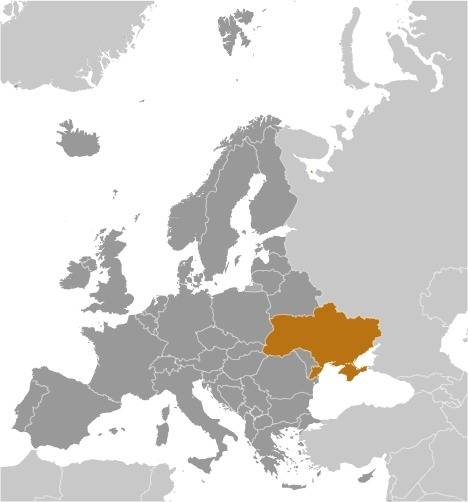 The security situation
Armed conflict erupted in eastern Ukraine in 2014, following Russia’s occupation and annexation of Crimea, dramatically affecting the lives of millions of people. On February 24, 2022, Russia escalated its conflict with Ukraine by invading the country on several fronts. The 2022 invasion has become the largest conventional military attack on a sovereign state in Europe and created the continent’s largest refugee crisis since World War II.
The invasion has received near universal international condemnation, and many countries have imposed sanctions on Russia and also supplied military aid to Ukraine. In contrast, China and India - the two most populous countries in the world - did not condemn the war and made virtually no effort to end the conflict, even though both countries are the only ones capable of contributing much to it.
The security situation in Ukraine deteriorated rapidly following the launch of the Russian military offensive, with forces crossing into the country from Belarus in the north, Russia in the east and Crimea in the south. The armed violence escalated in at least eight oblasts (administrative regions), including Kyiv Oblast, Kharkiv Oblast, and Chernihiv Oblast, as well as in the eastern oblasts Donetsk and Luhansk which were already affected by the 2014 conflict.
After Russian withdrawal of troops from the Kyiv, Chernihiv and Kharkiv Oblasts, the security situation improved there, at least temporarily. Subsequently, Russia’s self-declared main effort has been on taking control of the Donbas region, though missile attacks and other airstrikes on large urban centers in the whole of Ukraine continue.
Since the summer of 2022, however, most of the fighting has been confined to the east, north and south of the country. The war in Ukraine shows no signs of abating and drives high humanitarian needs across the country, especially in the Donbas region and the southern oblasts of Mykolaiv, Kherson and Zaporizhzhia. While active fighting continues near the front lines, civilians bear the brunt of constant attacks.
In a further escalation of the conflict, Russia declared on September 30, 2022 the annexation of Donetsk, Kherson, Luhansk, and Zaporizhzhia regions into the territory of the Russian Federation. On October 10, 2022, the Russian president announced targeted attacks on Ukraine's energy infrastructure. As the Russian Federation rhetorically threatens NATO member states and the use of nuclear weapons, the Ukraine crisis risks escalating into a Third World War with unforeseeable consequences for billions of people globally.
In its first comprehensive report on the situation in Ukraine since Russia's invasion on February 24, 2022, issued in March 2023, the Independent International Commission of Inquiry on Ukraine concluded that the Russian authorities have committed numerous violations of international humanitarian law and international human rights law, in addition to a wide range of war crimes.
The war crimes include attacks on civilians and energy-related infrastructure, willful killings, torture and inhuman treatment, unlawful confinement, rape and unlawful transfers and deportations of children from Ukraine to the Russian Federation. Some of the serious violations of the law may amount to crimes against humanity.
The Commission said it was concerned about the continued use of explosive weapons in civilian areas. It noted that the multiplicity of such attacks confirms a pattern of disregard by Russian forces for possible harm to civilians.
In March 2024, the Independent International Commission of Inquiry on Ukraine presented an update to the UN Human Rights Council. The UN investigators accused the Russian authorities of violating basic human rights principles and causing untold suffering to Ukrainian prisoners of war and civilians by subjecting them to appalling treatment.
The report highlights an escalation in civilian suffering two years after the full-scale invasion of Ukraine by Russian forces, and attributes the violations to a disregard for basic humanitarian principles and obligations to uphold human rights.
In September 2024, the Commission of Inquiry presented another report on the situation in Ukraine to the Human Rights Council, in which investigators accused Russia of using torture and sexual violence with impunity against Ukrainian citizens and prisoners of war in occupied Ukrainian territory and in the Russian Federation.
Human rights groups have also documented widespread violations of international human rights and humanitarian law in Ukraine since Russia's full-scale invasion began in 2022, including acts that amount to war crimes and crimes against humanity.
Since March 2023, the International Criminal Court (ICC) has issued several arrest warrants for Russian President Vladimir Putin and senior Russian officials. In June 2023, UN Secretary-General António Guterres added Russia to a blacklist of perpetrators of grave violations against children, citing Moscow's actions in Ukraine, including the killing and maiming of children and attacks on schools.
Throughout 2023, the war continued to wreak havoc in Ukraine. The killing and injury of thousands of civilians, including children, the targeting of civilian infrastructure, the disruption of livelihoods and vital services as well as prolonged displacement have triggered a massive humanitarian and protection crisis.
In 2024, Ukraine experienced a sharp increase in airstrikes, artillery attacks, and ground fighting along frontline communities, causing widespread devastation and civilian losses. There was a 30 percent increase in civilian casualties compared to 2023, and the humanitarian situation worsened, especially in frontline areas.
In 2025, the war in Ukraine intensified and expanded geographically, deepening the impact on civilians and generating additional humanitarian needs. Expansion of hostilities in the front-line oblasts has rendered villages and towns uninhabitable. The systematic use of drones, glide bombs and long-range strikes changed the nature of the war, causing civilian harm far beyond the front lines—including the capital of Kyiv.
For the fourth winter, Ukrainians faced insecurity and compounded exhaustion from living in a war zone as their country’s energy infrastructure was attacked. Russia intensified its deployment of missiles and long-range drones, with hundreds of munitions launched in frequent large-scale overnight attacks.
Frontline regions have experienced a severe deterioration in living conditions as short-range drones, aerial bombs, and other munitions cause extensive damage to residential buildings and other vital civilian infrastructure. In some frontline towns, hospitals and clinics have been destroyed or forced to close, leaving residents without access to basic healthcare. Disruption of water, heating, and electricity further reduce the ability of civilians, particularly older persons and persons with disabilities, to remain in their homes.
Russia's continued assault has also compromised Ukraine's economy and devastated the country's energy sector. Many Ukrainian businesses have closed or been destroyed. Since 2022, millions of jobs have been lost in Ukraine. Hundreds of attacks on energy infrastructure have affected energy supplies across the country, causing prolonged power outages for millions of people.
Donations
Your donation for the Ukraine emergency can help United Nations agencies, international humanitarian non-governmental organizations (NGOs) and their local partners to rapidly provide water, food, medicine, shelter and other aid to the people who need it most.
- UN Crisis Relief: Ukraine emergency
https://crisisrelief.un.org/ukraine-crisis - International Committee of the Red Cross (ICRC): Ukraine humanitarian crisis
https://www.icrc.org/en/donate/ukraine - UNHCR: Ukraine emergency
https://www.unhcr.org/ukraine-emergency.html - International Rescue Committee (IRC): Ukraine crisis
https://www.rescue.org/topic/ukraine-crisis - UNICEF: War in Ukraine
https://www.unicef.org/emergencies/war-ukraine-pose-immediate-threat-children - World Food Programme: Ukraine emergency
https://www.wfp.org/emergencies/ukraine-emergency - Plan international: Ukraine appeal
https://plan-international.org/emergencies/ukraine-appeal/ - Action Against Hunger: Ukraine emergency response
https://www.actionagainsthunger.org/donate/ukraine-emergency-response
Many people are already donating to the emergency relief effort in Ukraine. If you would like to support humanitarian crises worldwide with a contribution, you can donate directly to the United Nations Central Emergency Relief Fund (CERF).
- UN Crisis Relief: Central Emergency Response Fund
https://crisisrelief.un.org/t/cerf
To find other organizations to which you can donate, visit: Humanitarian Crisis Relief, Refugees and IDPs, Children in Need, Hunger and Food Insecurity, Medical Humanitarian Aid, Vulnerable Groups, Faith-Based Humanitarian Organizations, and Human Rights Organizations.
Further Information
- UN OCHA: Situation Report Ukraine
https://reports.unocha.org/en/country/ukraine/ - UNHCR Operational Data Portal: Ukraine Refugee Situation
https://data.unhcr.org/en/situations/ukraine - United Nations in Ukraine
https://ukraine.un.org/en - Reliefweb: Ukraine
https://reliefweb.int/country/ukr - ACAPS: Ukraine conflict
https://www.acaps.org/country/ukraine/crisis/conflict - UN Office of the High Commissioner for Human Rights (OHCHR): Ukraine
https://www.ohchr.org/en/countries/ukraine - Council on Foreign Relations: Global Conflict Tracker: Conflict in Ukraine
https://www.cfr.org/global-conflict-tracker/conflict/conflict-ukraine - European Civil Protection and Humanitarian Aid Operations (ECHO): Ukraine
https://civil-protection-humanitarian-aid.ec.europa.eu/where/europe/ukraine_en - International Crisis Group: Ukraine
https://www.crisisgroup.org/europe-central-asia/eastern-europe/ukraine - Human Rights Watch (HRW): World Report 2026: Ukraine
https://www.hrw.org/world-report/2026/country-chapters/ukraine - Human Rights Watch (HRW): World Report 2025: Ukraine
https://www.hrw.org/world-report/2025/country-chapters/ukraine - Human Rights Watch (HRW): World Report 2024: Ukraine
https://www.hrw.org/world-report/2024/country-chapters/ukraine - Human Rights Watch (HRW): World Report 2023: Ukraine
https://www.hrw.org/world-report/2023/country-chapters/ukraine - Amnesty International: World Report 2025/2026: Human rights in Ukraine
https://www.amnesty.org/en/location/europe-and-central-asia/ukraine/report-ukraine/
Last updated: 22/06/2026