Home
DONARE
  • German
  • English

Main navigation

  • Home
    • Humanitarian Crisis Relief
    • Children in Need
    • Hunger and Food Insecurity
    • Refugees and IDPs
    • Medical Humanitarian Aid
    • Faith-Based Humanitarian Organizations
    • Vulnerable Groups
    • Human Rights Organizations
    • Climate Crisis and Climate Change
    • US Organizations
    • UK Organizations
    • Canadian Organizations
    • Australian Organizations
    • Directory
    • Emergency Appeals
  • News
    • All headlines
    • News Monitor
    • Articles
    • Mental health in humanitarian emergencies
    • Millions will die because of brutal funding cuts
    • Donate for humanitarian causes
    • Climate change & humanitarian crises
    • Humanitarian action is needed now
    • Humanitarian aid & human rights
    • The world's largest economies must do more
    • Why I donate to CERF
    • Thank you
    • How to write to a Member of Parliament
    • Reputable donation organizations in the United States
    • Earmarked or unearmarked donations
  • Background
    • Humanitarian Emergencies
    • Key Players in Humanitarian Aid
    • Forgotten Crises
    • Where does your money go?
    • Largest Humanitarian Donors
    • Websites for Experts and Professionals
    • Information for Journalists
    • Humanitarian Jobs
    • Glossary
    • Frequently Asked Questions (FAQs)
  • Ways to Help
    • Start a Fundraiser
    • Hold Your Government to Account
    • Volunteering in Humanitarian Aid
    • Start a Petition or Sign a Petition
    • Sponsor a Child
  • About us
    • Welcome to DONARE
    • Principles and guidelines
    • Donare means donate
    • FAQs about DONARE
    • Support us
    • Archive
    • Content
    • Tags
    • Topics
    • Contact

Breadcrumb

  1. Humanitarian News

Report highlights urgent need to tackle global hunger

By Simon D. Kist, 10 October, 2025

The Global Hunger Index (GHI) 2025, published on Thursday, paints a bleak picture of the world's progress towards the United Nations' Sustainable Development Goal (SDG) of achieving zero hunger by 2030. With at least 56 countries projected to miss the low hunger threshold, and 42 currently experiencing serious or alarming levels of hunger, the report emphasizes the need for renewed commitment and urgent action.
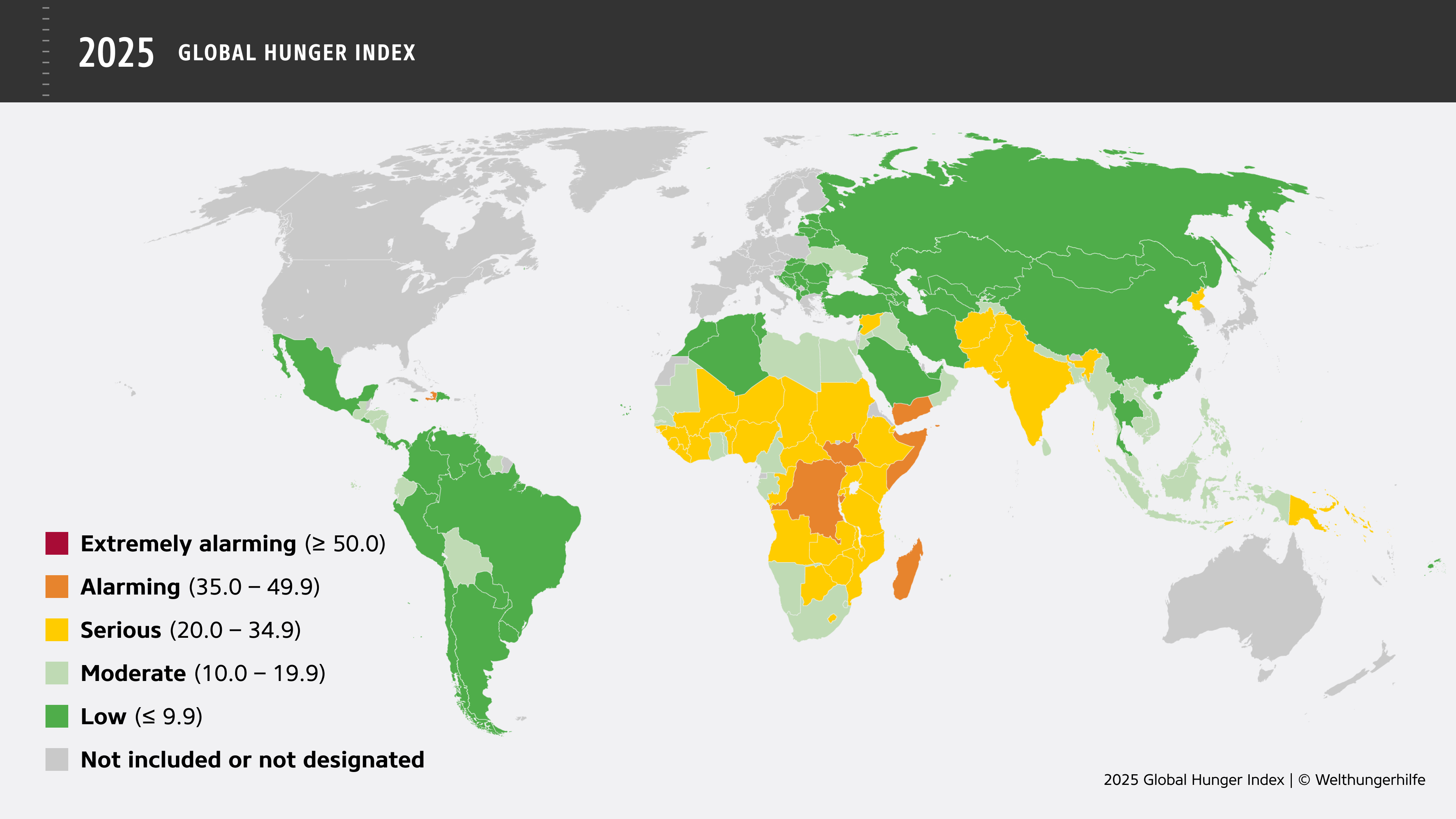
Global Hunger Index 2025 by severity
Global Hunger Index 2025 by severity © Welthungerhilfe

According to the GHI, published by the Irish humanitarian organization Concern Worldwide, the German aid agency Welthungerhilfe, and the Institute for International Law of Peace and Armed Conflict (IFHV), the global GHI score has barely improved since 2016. This lack of progress is attributed to overlapping and accelerating global crises, including armed conflict, climate shocks, economic fragility, and political disengagement.

The report warns that, at the present rate of progress, it will take more than a hundred years to reach low hunger levels globally.

“At the current pace, at least 56 countries will not reach low hunger — let alone Zero Hunger — by 2030,” warned Réiseal Ní Chéilleachair, Concern Worldwide Director of Strategy, Advocacy and Learning, during the report's launch.

“If progress remains at the pace observed since 2016, low hunger at the global level may not be reached until 2137 — more than a century away.”

The report emphasizes the urgent need for action in countries such as Burundi, the Democratic Republic of the Congo (DRC), Haiti, Madagascar, Somalia, South Sudan, and Yemen, where the level of hunger is considered alarming. Additionally, 35 countries experienced serious levels of hunger.

The report’s authors express concern about data gaps that prevented GHI scores from being calculated for Sudan, the Occupied Palestinian Territories (including Gaza), Yemen, Burundi, and the Democratic People’s Republic of Korea (DPRK).

According to the GHI, these gaps obscure the true extent of hunger in these countries, though available indicators point to deteriorating conditions, suggesting that the reality is more alarming than current figures reveal.

The Integrated Food Security Phase Classification (IPC), the world’s leading authority on acute food security, reports that man-made famines are currently occurring in Sudan due to the war that erupted in 2023, resulting in the world's largest hunger crisis, and in the Gaza Strip due to Israeli blockades and obstructions to humanitarian aid and commercial goods.

“Wars such as those in the Gaza Strip and Sudan have led to catastrophic famines. Decisive action and international political commitment are needed to overcome hunger,” said Mathias Mogge, Secretary General of Welthungerhilfe.

In contrast, parts of South and Southeast Asia, as well as Latin America, have reduced hunger due to stability and investment, according to the GHI. Sustained investments can drive meaningful progress in hunger reduction, as demonstrated in Angola, Bangladesh, Ethiopia, India, Nepal, and Sierra Leone.

Chéilleachair stressed that “hunger is not inevitable. It is a result of the lack of sustained political will, policy failure, policy financing, and implementation.”

“Progress is evident in a number of countries, the report shows, especially on undernourishment. The international community needs to re-energize, re-commit and re-focus its efforts to tackle global hunger levels, prioritizing communities and people who are most affected,” she added.

The report notes that the lack of progress toward achieving the SDG is evidence of leaders’ policy ambivalence, as stated ambitions are not being met with adequate resources or actions.

“Putting it in simple terms, talk is not being backed by action,” Chéilleachair said.

Rather than correcting their course, many decision-makers are ignoring or underinvesting in commitments they have already made. They are doubling down on destabilizing policies. Vital monitoring and early-warning systems used to track hunger are being undermined by security risks, bureaucratic impediments, and funding cuts that hinder aid delivery and data collection.

The GHI 2025 is being published at a time when humanitarian funding is being cut drastically and military spending is on the rise. Humanitarian assistance is increasingly limited to the most acute cases only, leaving millions without support.

“Last year alone, wars triggered 20 acute hunger crises worldwide, affecting nearly 140 million people. At a time when challenges are increasing, the financial resources needed to overcome hunger worldwide are being cut,” said Marlehn Thieme, chair of the board of Welthungerhilfe.

“The German government should reverse the planned cuts to humanitarian assistance in the 2026 budget — otherwise it is the most vulnerable who will pay the price.”

This year's GHI includes a total of 136 countries. While countries in Sub-Saharan Africa and South Asia continue to have the worst GHI scores, the main causes of global hunger remain ongoing wars and armed conflicts, the consequences of climate change, and a lack of political will to act.

The report ranks countries based on four key indicators: undernourishment, child stunting, child wasting, and child mortality. Countries receive a score on a 100-point scale measuring the severity of hunger, with zero representing no hunger and 100 representing the worst conditions.

Further information

Full text: Global Hunger Index 2025, Concern Worldwide, Welthungerhilfe, Institute for International Law of Peace and Armed Conflict (IFHV), report, published on October 9, 2025
https://www.globalhungerindex.org/pdf/en/2025.pdf

Website: Global Hunger Index (GHI)
https://www.globalhungerindex.org/

Tags

  • Hunger
  • Underfunded Emergency
  • Burundi
  • Democratic Republic of the Congo
  • Haiti
  • Madagascar
  • Somalia
  • South Sudan
  • Yemen
  • Sudan
  • Occupied Palestinian Territory

Latest news

  • US humanitarian aid: UN funds receive $2 billion contribution after extreme cuts of $10 billion
  • Somalia: 4.6 million people impacted by drought amid severe funding shortfalls
  • DR Congo: UN humanitarian chief releases funding for urgent response to large-scale displacement
  • Sudan war: UN Security Council urged to prevent horrors of conflict from recurring
  • Ukraine: Hostilities continue to cause civilian casualties and damage key infrastructure
  • Ethiopia: 1.1 million lives at risk as funds for refugees dry up
  • Gaza: Famine conditions offset, but situation remains critical
  • IRC: Sudan, OPT, and South Sudan top 2026 Emergency Watchlist
  • Deepening hunger crisis hits Afghanistan as winter sets in
  • Syria: Relief agencies deliver aid to southern areas despite severe funding shortfalls
  • Sudan war: Agreement reached to access famine-stricken El Fasher, aid teams report
  • DR Congo: Over 500,000 people displaced by South Kivu clashes
  • Myanmar: 16.2 million people will require humanitarian assistance in 2026
  • Central Emergency Response Fund: Donors pledge just $300 million for 2026
  • UN seeks $33 billion to save millions amidst deepest funding cuts ever
  • South and Southeast Asia: Deadly floods and landslides impact 11 million people
  • Central African Republic: Armed violence impacts civilians in the south-east
  • Northern Mozambique: More than 100,000 people newly displaced as violence spreads and support is lacking
  • Sri Lanka: Widespread flooding and landslides leave 390 people dead and 352 missing
  • Sudan crisis: Insecurity, displacement drive rising humanitarian needs
  • Gaza: Despite ceasefire, UN staff and facilities face grave risks
  • Lebanon ceasefire: One year on, Israeli attacks continue to kill civilians
  • DR Congo: Fighting and restrictions undermine humanitarian access in South Kivu
  • Northern Nigeria: Mounting attacks drive sharp spike in hunger
  • Sub-Saharan Africa: EU allocates €143 million in humanitarian aid
  • Ukraine: Drone strikes pose a growing risk to aid operations
  • Colombia: Ongoing conflict interrupts access to humanitarian assistance
  • Staggering numbers: 318 million people are expected to face acute hunger in 2026
  • Gaza: UN Security Council authorizes temporary international force
  • OCHA: Armed conflict is driving the world’s most severe hunger crises
  • Somalia: Drought and severe funding shortfalls compound humanitarian crisis
  • UN warns of deepening food crisis in 16 hunger hotspots
  • Sudan war: Catastrophic conditions persist in North Darfur as displacement surges
  • Hurricane Melissa affects over 5 million people across Jamaica, Cuba, and Haiti
  • DR Congo: Amid ongoing fighting and lack of funding for aid, hunger crisis worsens
  • South Sudan: Hunger and malnutrition intensify; tens of thousands face risk of famine
  • Madagascar faces deepening humanitarian crisis
  • Gaza: One million people receive food parcels as aid agencies race to push back hunger
  • Hurricane Melissa’s aftermath: Coordinated humanitarian response underway across the Caribbean
  • Sudan: More details emerge about mass atrocities in El Fasher as catastrophic situation persists
RSS feed
  • Humanitarian Emergencies
    • Sudan Crisis
    • Palestine Crisis
    • Myanmar Crisis
    • Crisis in the Democratic Republic of Congo
    • Haiti Crisis
    • Afghanistan Crisis
    • Ukraine Crisis
    • Yemen Crisis
    • South Sudan Crisis
    • Lebanon Crisis
    • Syria Crisis
    • Sahel Crisis
    • Mozambique Crisis
    • Somalia Crisis
    • Ethiopia Crisis
    • Central African Republic Crisis
    • Colombia Crisis
    • Burundi Crisis
    • Venezuela Crisis
    • Central America Crisis
    • Further Crises
  • Humanitarian News
    • All Headlines
    • News Monitor
    • Articles
      • Mental health in humanitarian emergencies
      • Millions will die because of brutal funding cuts
      • Why you should donate to humanitarian causes
      • Humanitarian aid and human rights
      • Climate change and humanitarian crises
      • The world's largest economies must do more
      • Earmarked or unearmarked donations
      • Why I donate to CERF
      • How to write to a Member of Congress or Member of Parliament
      • Humanitarian action is needed now
      • Thank you
      • Reputable donation organizations in the United States
  • Humanitarian Organizations
    • By Issue
      • Humanitarian Crisis Relief
      • Children in Need
      • Hunger and Food Insecurity
      • Refugees and IDPs
      • Medical Humanitarian Aid
      • Vulnerable Groups
      • Faith-Based Humanitarian Organizations
      • Related Issues
      • Human Rights Organizations
      • Climate Crisis and Climate Change
    • By Country
      • Humanitarian Organizations United States
      • Humanitarian Organizations United Kingdom
      • Humanitarian Organizations Canada
      • Humanitarian Organizations Australia
    • Directory
      • Aid Agencies Worldwide
      • Aid Agencies United States
      • Aid Agencies United Kingdom
      • Aid Agencies Canada
      • Aid Agencies Australia
  • Background
    • Key Players in Humanitarian Aid
    • Forgotten Crises
    • Where does your money go?
    • The Largest Humanitarian Donors
    • Websites for Experts and Professionals
    • Information for Journalists
    • Humanitarian Jobs
    • Glossary
    • Frequently Asked Questions (FAQs)
      • FAQs: Humanitarian Actors
      • FAQs: Humanitarian Aid
      • FAQs: Humanitarian Crises
      • FAQs: Humanitarian Funding
      • FAQs: International Humanitarian Law
  • Ways to Help
    • Start a Fundraiser
    • Volunteering in Humanitarian Aid
    • Hold Your Government to Account
    • Start a Petition or Sign a Petition
    • Sponsor a Child
  • About DONARE
    • Welcome to DONARE
    • Principles and guidelines
    • FAQs about DONARE
    • Donare: Meaning and Origin
    • Archive
    • Content
    • Tags and Topics
      • Tags
      • Topics
    • Support Us
    • Contact
DONARE logo

donare.info : Privacy Policy - Legal Notice

© 2022-2025 DONARE